

TV News, Movies
Can’t Take Our Eyes Off You: Inside Julia Stiles’ Tearful Ballroom Tribute to Heath Ledger and the Eternal Magic of 10 Things I Hate About You
Oct
1. The Tears in the Rehearsal Room: A Ballroom Dedication Twenty-Seven Years in the Making
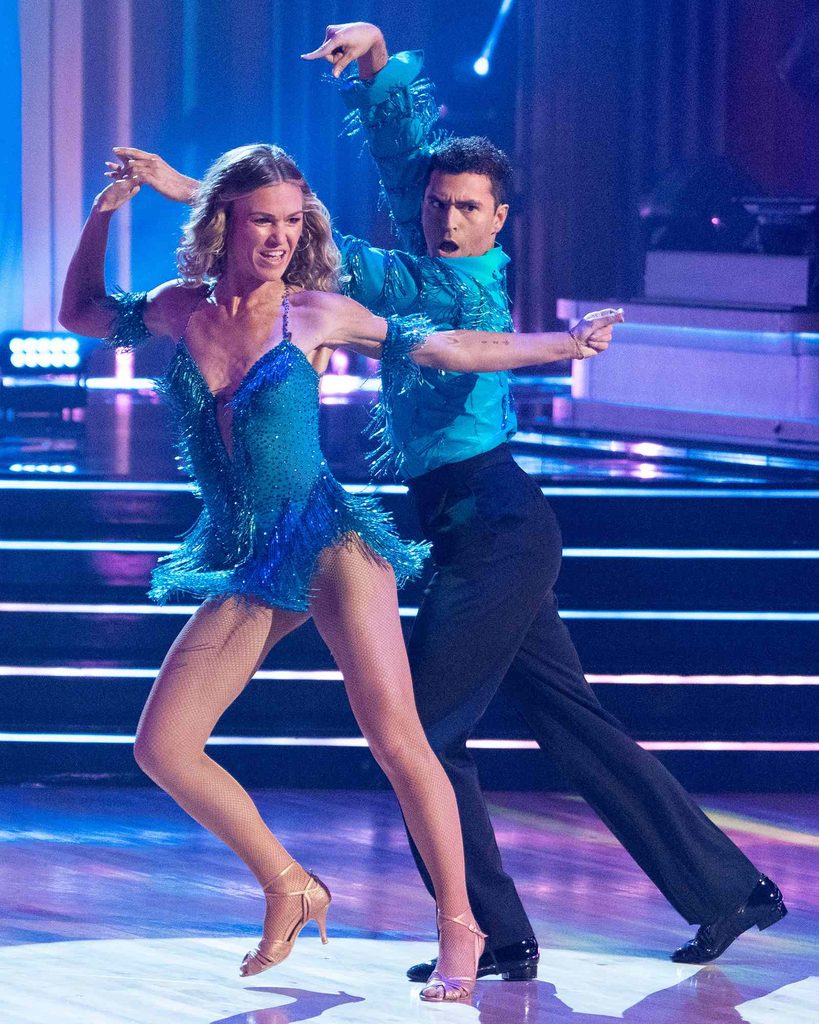
Inside the mirrored, daylight-drenched rehearsal studios of Dancing With the Stars in Los Angeles, the familiar, brassy opening horns of Frankie Valli’s 1967 immortal pop anthem ‘Can’t Take My Eyes Off You’ echoed across the hardwood floors. For millions of music lovers across generations, those soaring horns evoke pure, unadulterated euphoria—the timeless sensation of falling hopelessly, head-over-heels in love. But for forty-five-year-old actress Julia Stiles, standing center stage in rehearsal sneakers beside her professional dance partner Ezra Sosa, the first beat of the chorus triggered an entirely different, overwhelming emotional reaction: a sudden, unstoppable cascade of tears.
Stiles, competing in Season 35 of ABC’s flagship ballroom competition, was preparing for the season’s most sacred ritual: ‘Dedication Night.’ In the reality television pantheon, Dedication Night has long served as an emotional crucible where celebrity contestants strip away their competitive armor to perform a routine dedicated to the defining figures, tragedies, or milestones of their lives. Yet as Stiles and Sosa worked through the fluid, contemporary choreography of their routine, the veteran actress found herself gripped by an acute, visceral wave of grief that caught her entirely off guard.
‘I was crying in rehearsals today,’ Stiles admitted with raw, disarming vulnerability in an exclusive conversation with Variety. ‘And it’s so crazy, it sounds so stupid when I say this, but I didn’t expect it. Of course, I watch the show, I know that ‘Dedication Night’ is emotional. But I thought… I felt like I was distanced from it enough. Like, ‘Oh, it was so many years ago.’ But revisiting those memories, hearing that music, hearing his voice… it’s a lot. It just hit me all at once.’
To translate that complex emotional tapestry onto the ballroom stage, partner Ezra Sosa crafted a contemporary routine that meticulously wove signature motifs from the 1999 film into the physical choreography. Sosa designed moments that directly echoed Patrick Verona’s playful, swaggering movement: the triumphant leap across imaginary stadium benches, the theatrical hands-on-hips defiance, the delicate, slow-motion spins that recalled the paint-splattered balloon fight in the paddleboat scene, and a climactic, suspended lift that mirrored the breathless exhilaration of young romance.
The emotional resonance backstage was equally profound. During camera dress rehearsals earlier in the afternoon, fellow contestants, including Tatyana Ali and Alfonso Ribeiro, stood quietly in the studio wings, completely transfixed by the vulnerability Stiles brought to each step. Crew members who had worked on television soundstages for decades wiped away tears as the rehearsal finished, marveling at how Sosa’s choreography managed to balance the somber weight of grief with the celebratory, incandescent light of youthful devotion.
When the routine was finally presented under the glowing lights of the DWTS ballroom, the atmosphere inside the studio was electric with reverence. The LED floor beneath the dancers’ feet shimmered with projection mapping depicting rain-drenched stadium steps and faded golden autumn leaves, while soft amber and violet spotlights enveloped the pair in a cinematic haze. By the time the final chords of Frankie Valli’s brass fanfare faded into silence, judges Carrie Ann Inaba, Derek Hough, and Bruno Tonioli were openly wiping away tears, while the studio audience rose in a roaring, unbroken standing ovation.
The man commanding that profound outpouring of love and remembrance is, of course, the late, legendary Heath Ledger.
To anyone who came of age at the twilight of the twentieth century, the song ‘Can’t Take My Eyes Off You’ is indelibly, permanently tethered to a singular moment in cinematic history. In the spring of 1999, inside the Gil Junger-directed teen romantic comedy masterpiece 10 Things I Hate About You, a nineteen-year-old Australian newcomer named Heath Ledger bounded onto the concrete bleachers of Tacoma’s Stadium High School. Dressed in a ratty green henley, flashing a dimpled, rakish grin, and brandishing a stolen marching-band microphone, Ledger’s character, Patrick Verona, serenaded Stiles’ proudly abrasive, fiercely feminist Kat Stratford across an entire football field, dodging bewildered security guards and joyfully sliding down brass handrails. It was the cinematic equivalent of a lightning strike: an unforgettable, heart-stopping declaration of romantic devotion that instantly minted Ledger as a global superstar and carved itself permanently into the collective heart of a generation.
Ledger’s untimely, catastrophic death in January 2008 at the tender age of twenty-eight permanently froze that radiant youth in amber. In the eighteen years that have elapsed since his passing, Stiles has navigated her own distinguished, multifaceted career—anchoring landmark films like Save the Last Dance, Mona Lisa Smile, The Omen, and the multi-billion-dollar Jason Bourne franchise, while expanding into prestigious stage work and independent directing. Yet no matter how many decades pass, the ghost of Patrick Verona has remained a tender, living presence in her artistic soul.
In a candid live broadcast with fans on social media alongside partner Ezra Sosa, Stiles elaborated on the delicate philosophical tightrope she sought to walk with the tribute: ‘It was important to me that, in the music and in the dance, we have the somber tribute to him, because obviously he’s passed away and he’s no longer with us. But also, that scene brings so much joy to people. His energy in that movie was so bright, so radiant, so completely full of life. We wanted to have the joyful celebration of when he was around. We wanted people to smile through their tears.’
As the ballroom lights dimmed and the orchestra swelled for their live television performance, that dual purpose was achieved with breathtaking, poetic grace. Stiles was not merely executing steps; she was reaching across nearly three decades of time, using the physical poetry of dance to commune with a fallen brother whose light has never dimmed.
2. The Summer of 1998 in Tacoma: The Lightning-in-a-Bottle Chemistry of Kat Stratford and Patrick Verona
To truly understand the profound depth of Julia Stiles’ emotional connection to Heath Ledger, one must journey back to the enchanted Pacific Northwest summer of 1998, when a constellation of extraordinary, largely unknown young talents descended upon the coastal city of Tacoma, Washington, to film what was nominally conceived as a modest teen comedy.
The late 1990s witnessed an unprecedented wave of modern cinematic adaptations of classical literature, from Baz Luhrmann’s hyper-kinetic Romeo + Juliet to Amy Heckerling’s Jane Austen-inspired Clueless. In 10 Things I Hate About You, screenwriters Karen McCullah and Kirsten Smith undertook the notoriously thorny challenge of modernizing William Shakespeare’s controversial sixteenth-century comedy The Taming of the Shrew. In the hands of director Gil Junger, the patriarchal misogyny of the original Elizabethan text—wherein the headstrong Katherine Minola is psychologically broken and subjugated by the greedy nobleman Petruchio—was radically dismantled and inverted.
In their revolutionary reimagining, Kat Stratford was not a ‘shrew’ in need of taming; she was an unapologetic, riot-grrrl-listening, Sylvia Plath-reading teenage intellectual who rightfully rejected the superficial, sexist social hierarchies of late-nineties suburban high school life. To play Kat, Junger needed an actress of immense intellectual severity, someone whose fierce gaze could reduce arrogant teenage boys to dust. He found that formidable force in seventeen-year-old New York stage actress Julia Stiles, whose quiet intensity and emotional maturity gave Kat a revolutionary, non-conformist dignity.
Yet the entire architectural integrity of the film rested on finding an actor capable of standing opposite Stiles without being swallowed whole. The production searched through hundreds of young American actors, testing established heartthrobs who played Patrick Verona with predictable, sneering bad-boy hostility. Then, walking into the casting office straight off a flight from Perth, Western Australia, came nineteen-year-old Heath Ledger.
Junger would later recall the moment Ledger auditioned as an instantaneous epiphany. Ledger did not play Patrick as a cruel or menacing bully; he played him with a buoyant, soulful, and mischievous warmth that was utterly irresistible. He possessed the raw masculine magnetism of a young Marlon Brando combined with the comedic agility of Gene Kelly and the disarming vulnerability of a puppy.
When Stiles and Ledger were placed together in a room for a chemistry read, the air in the room crackled with palpable, kinetic static. It was an alchemical collision of opposites: Stiles’ guarded, razor-sharp New York skepticism clashing against Ledger’s sunny, laid-back Australian charm. Between the two young performers, the dialogue sang with the electric, rhythmic wit of a classic screwball comedy.
The off-screen dynamic among the young cast was equally fascinating and tenderly complex. Years later, director Gil Junger dropped a delightful biographical revelation during an interview with Argentine journalist Fede Carestía, revealing that while fans were desperate for Stiles and Ledger to become a real-life couple, Stiles was actually falling in love behind the scenes with co-star Joseph Gordon-Levitt (who played the lovesick Cameron James).
‘They were very, very attracted to each other, which was so cute,’ Junger recalled with a warm chuckle. ‘She’s professing her love to onscreen boyfriend Heath Ledger on camera, and then in between setups, she’s in love with the guy waiting in his trailer to shoot the next scene.’ Junger noted that Stiles and Gordon-Levitt dated ‘for a minute or ten,’ adding that ‘it was beautiful how much they enjoyed each other.’
What made the set truly miraculous was how Ledger handled the situation. Rather than succumbing to youthful male ego or professional jealousy, Ledger celebrated his castmates’ happiness unconditionally. He forged a deep, fraternal bond with Gordon-Levitt, treating him with the same warm generosity he extended to Stiles. The entire cast lived in a bubble of joyous, insular camaraderie. Staying together at the Sheraton Hotel in downtown Tacoma, the ensemble—including Stiles, Ledger, Gordon-Levitt, Larisa Oleynik, David Krumholtz, and Andrew Keegan—spent their evenings exploring local record stores, eating late-night dinners, and talking about their artistic dreams. They were unburdened by the cynicism of Hollywood, unchaperoned by armies of publicists, and blissfully unaware that they were creating an immortal cultural milestone.
As Stiles reflected in an emotional retrospective with E! News: ‘He was amazing. He was such a bright light. And while I had a wonderful time with the entire cast, Heath was just singular. He would walk into a room and the entire room would instantly light up. He possessed an innate generosity of spirit that made you feel completely safe.’
For Stiles, undertaking her very first leading role in a major studio film was a terrifying, high-stakes endeavor. In an industry where young actresses were routinely objectified, dismissed, or intimidated by aggressive male co-stars, Ledger treated her with an exquisite, tender respect. He was patient during technical rehearsals, celebrated her comedic timing, and created a sacred sanctuary of mutual trust where two teenagers could make mistakes, take creative risks, and fall into the rhythm of a romance that felt undeniably, breathtakingly real.
3. ‘This Is Your Scene’: Heath Ledger’s Radical Generosity and the Lost Hotel Note
While 10 Things I Hate About You is packed with uproarious physical comedy and iconic musical sequences, the film’s enduring emotional apex arrives in an English classroom during the third act, centered around an assignment to write an original poem in response to William Shakespeare’s Sonnet 141. It is a sequence that has brought millions of viewers to tears across three decades, and it stands as the ultimate testament to Heath Ledger’s radical artistic generosity.
In the scene, Kat Stratford stands before her classmates, clutching a crumpled piece of loose-leaf notebook paper, to read her poem addressing the devastating heartbreak of Patrick’s betrayal:
‘I hate the way you talk to me, and the way you cut your hair.
I hate the way you drive my car. I hate it when you stare.
I hate your big dumb combat boots, and the way you read my mind.
I hate you so much that it makes me sick; it even makes me rhyme…
But mostly I hate the way I don’t hate you.
Not even close, not even a little bit, not even at all.’
During the filming of that iconic sequence, something extraordinary occurred on Soundstage 1. Director Gil Junger had intentionally scheduled the scene toward the very end of principal photography, recognizing that the emotional exhaustion and real-world bonds of the cast would lend the moment raw authenticity. Junger made the bold directorial decision to shoot the scene in a continuous, unbroken medium-close master take on Stiles, avoiding rapid cutting or manufactured dramatic close-ups.
As Stiles began reciting the final stanzas, the emotional weight of the summer—the impending conclusion of production, the grief of saying goodbye to her creative family, and the raw vulnerability of the verse—overwhelmed her. Her voice cracked, tears welled in her eyes, and a genuine, unscripted sob escaped her throat. When Junger finally called ‘cut,’ the entire soundstage remained frozen in stunned, pin-drop silence for nearly two minutes before the cast, crew, and camera operators erupted into spontaneous, weeping applause. It was a moment of pure, unadorned human truth that completely transcended the script.
Yet what made that moment possible was what was happening on the other side of the camera lens.
In Hollywood, young actors vying for stardom frequently engage in subtle, competitive maneuvers to steal focus—shifting their eyelines, offering distracting reactions, or demanding reverse close-ups to ensure their own face shares equal screen time during dramatic climaxes. Ledger did the exact opposite. Recognizing that Stiles was experiencing a profound, fragile emotional breakthrough, Ledger actively retreated into the background. He stood quietly off-camera, anchoring her eyeline with stillness, patience, and profound reverence.
As Stiles recalled in a deeply moving interview with PEOPLE: ‘I remember Heath Ledger was so gracious about the whole thing. He wasn’t trying to compete with me. He stood back, and he was like, ‘This is your scene.’ You know, he had his amazing moments in the movie, too—the singing and dancing and running up and down those steps. But he was confident enough, even just starting out at nineteen years old, to be like, ‘I’m handing over the stage to you.’ And I learned way later in life that that doesn’t always happen. Male actors do not always hand you the stage.’
That selfless grace extended far beyond the soundstage. Following the emotional wrap party in Tacoma, as the cast packed their bags to return to their separate lives across the globe, Ledger left Stiles a parting gift that would become one of the most treasured, heartbreaking artifacts of her life.
Years after Ledger’s death, while sorting through old childhood mementos in her New York apartment, Stiles unearthed a forgotten slip of stationery from the Sheraton Hotel in Tacoma. Written in Ledger’s distinctive, sprawling handwriting in faded blue ballpoint ink was a private farewell message to his co-star. The note concluded with a timeless poetic blessing that Ledger had lived by:
‘Dance like you’ve never heard the music, and love like you’ve never been hurt.’
When Stiles rediscovered that note, the emotional impact was devastating. ‘I almost cried,’ she shared quietly. ‘That was his goodbye note to me. It was so sweet, so pure, and so entirely Heath.’ In those thirteen handwritten words lay the entire philosophy of Heath Ledger’s existence: an invitation to live with abandon, to create without fear of embarrassment, and to love without building defensive walls around the heart. It is a philosophy that Stiles carried directly onto the ballroom floor of Dancing With the Stars twenty-seven years later.
4. An Untimely Eclipse: Grief, Stardom, and the Tragedy of January 2008
The sheer emotional resonance of Julia Stiles’ ballroom dedication cannot be separated from the agonizing, premature eclipse of Heath Ledger’s life. To look upon Ledger’s radiant, smiling face on the Stadium High School bleachers is to mourn not merely an actor, but one of the most transcendent, singular artistic trajectories in modern cinema history.
Following the breakout triumph of 10 Things I Hate About You, Hollywood executives clamored to box Ledger into the lucrative, narrow archetype of the commercial teen heartthrob. He was offered starring roles in glossy romantic comedies, interchangeable teen slashers, and glossy action tentpoles. Yet Ledger possessed an uncompromising, restless artistic integrity that abhorred commercial safety. He actively sabotaged his own heartthrob status, turning down millions of dollars to seek out dark, challenging, and unglamorous roles that would test the limits of his psychological instrument.
He threw himself into historical drama in The Patriot, anchored heroic medieval adventure in A Knight’s Tale, and bared his soul in the harrowing Australian addiction drama Candy. Then, in 2005, Ledger delivered a performance that permanently altered the cultural landscape of global cinema: Ennis Del Mar in Ang Lee’s groundbreaking masterpiece Brokeback Mountain.
Opposite Jake Gyllenhaal, Ledger crafted a portrait of repressed love, rural homophobia, and suffocating internal torment that critics universally compared to the greatest work of Marlon Brando and Montgomery Clift. Speaking in a muffled, guttural whisper that seemed dragged up from the bottom of a well, Ledger embodied a man whose inability to express his love destroys his soul. The performance earned Ledger his first Academy Award nomination for Best Actor at just twenty-six years old, establishing him unequivocally as the premier dramatic actor of his generation.
Three years later, Ledger undertook the role that would cement his immortality: the Joker in Christopher Nolan’s superhero opus The Dark Knight. Completely reinventing the comic-book villain from the ground up, Ledger vanished entirely beneath scarred white greasepaint, stringy green hair, and a tongue-flicking, anarchic physical mania that terrorized audiences and redefined cinematic antagonism. His Joker was not a theatrical clown; he was an agent of pure, terrifying philosophical chaos.
Yet the sheer, all-consuming intensity of Ledger’s craft took a devastating physical and mental toll. Plagued by chronic insomnia and severe physical exhaustion, Ledger struggled to quiet his racing mind when cameras stopped rolling.
On the afternoon of January 22, 2008, the world stopped spinning. Heath Ledger was found unresponsive in his rented apartment in the SoHo neighborhood of Manhattan, dead from an accidental overdose of prescription medications. He was twenty-eight years old. He left behind his beloved two-year-old daughter, Matilda—born of his deep, transformative relationship with his Brokeback Mountain co-star Michelle Williams—and legions of stunned, weeping colleagues across the globe. Today, Matilda has grown into a vibrant, twenty-year-old woman who carries her father’s radiant, unmistakable smile, his expressive brown eyes, and his adventurous, artistic spirit.
A year later, at the 81st Academy Awards, Ledger was posthumously awarded the Oscar for Best Supporting Actor, accepted on his behalf by his grieving family in one of the most tearful, emotionally devastating moments in telecast history. His contemporaries—from Jake Gyllenhaal and Christian Bale to Naomi Watts and Christopher Nolan—have continually affirmed that Ledger was an artist decades ahead of his time, a visionary whose creative hunger was matched only by his boundless empathy for other human beings.
For Julia Stiles, learning of Ledger’s death was a seismic shock that permanently severed her from the innocence of her youth. ‘It was so sad,’ Stiles reflected years later. ‘That was such an amazing time for all of us on 10 Things, and we were all so young and so innocent. When a friend phoned to tell me that Heath had died, I was completely paralyzed. You just couldn’t reconcile that someone with that much vibrant life inside them could simply vanish.’
In dedicating her ballroom dance to Ledger on national television, Stiles performed an act of collective mourning for a generation of movie lovers. She reminded the world that before the dark torment of Ennis Del Mar and before the terrifying genius of the Joker, Heath Ledger was a nineteen-year-old boy dancing in the rain on a high school bleacher, full of laughter, mischief, and boundless love.
5. The Undying Anthem of Youth: Why 10 Things I Hate About You Endures as a Generational Touchstone
The extraordinary, viral reaction to Julia Stiles’ tribute on Dancing With the Stars speaks to a cultural truth that extends far beyond standard nostalgic reminiscence: 10 Things I Hate About You is not merely a beloved vintage movie; it is an inviolable cultural touchstone that occupies an immortal sanctuary in the collective heart of modern cinema.
In an entertainment landscape currently saturated with focus-grouped content, algorithmic formulas, and sanitized teen programming designed for passive smartphone consumption, 10 Things I Hate About You stands as a towering monument to a lost golden age of adolescent storytelling. Released during the miracle cinematic year of 1999—a year that produced The Matrix, Fight Club, The Sixth Sense, American Beauty, and Magnolia—the film possessed a literacy, a wit, and an emotional authenticity that modern teen dramas rarely dare to attempt. Today, high school and university literature courses across North America routinely teach the film as the premier masterclass in adapting classical Elizabethan comedy into contemporary social satire, proving that popular entertainment can achieve both massive commercial appeal and enduring literary merit.
Equally central to the film’s immortal cultural footprint was its electrifying alternative rock soundtrack. Anchored by the explosive, joyful power-pop of Letters to Cleo—who famously performed their iconic cover of ‘I Want You to Want Me’ atop the gothic roof of Stadium High School in the film’s final helicopter shot—alongside tracks by Save Ferris, Semisonic, The Cardigans, and Joan Armatrading, the music gave voice to the chaotic, soaring emotional turbulence of late-1990s youth. The soundtrack didn’t talk down to teenagers; it vibrated with the raw, melodic urgency of young people discovering their own independent identities.
At its core, the film endures because Kat Stratford and Patrick Verona represented an entirely new, liberating blueprint for young love. Kat Stratford was a revelation for millions of young women who felt alienated by the passive, male-pleasing heroines of conventional nineties cinema. Kat did not apologize for her anger; she did not hide her intellect; and she refused to smile on command for the comfort of fragile men. She listened to Bikini Kill and Letters to Cleo, drove a battered 1964 Dodge Dart, and demanded to be met on her own intellectual terms.
And in Patrick Verona, the film provided the ultimate subversion of toxic masculinity. Patrick did not fall in love with Kat because she had a makeover, straightened her hair, or softened her edges; he fell in love with her precisely because of her fierce, uncompromising fire. When Patrick sings ‘Can’t Take My Eyes Off You’ across that stadium, he is not mocking her or asserting dominance; he is committing social suicide on her behalf, joyfully making a fool of himself in front of hundreds of peers to prove that her happiness is worth any amount of public humiliation.
That singular dynamic explains why the film has experienced a massive, unprecedented renaissance among Gen Z and Gen Alpha audiences across platforms like TikTok and Letterboxd. For teenagers navigating the isolating, hyper-curated, and anxious reality of the digital era, watching Julia Stiles and Heath Ledger spar on 35mm film feels like discovering an ancient, magical artifact of authentic human connection. They recognize that the spark between Kat and Patrick was not manufactured by visual effects or marketing algorithms; it was the raw, unrepeatable magic of two brilliant young actors pouring their authentic souls into the frame.
When Julia Stiles took the dance floor beside Ezra Sosa, sweeping across the ballroom as Frankie Valli’s voice soared toward the heavens, the performance transcended the confines of a television competition. It became an act of generational healing.
Watching Stiles dance was a reminder of the precious, fragile beauty of time. She danced for the seventeen-year-old girl who once stood before a camera in Tacoma weeping over an unrhymed poem. She danced for the nineteen-year-old boy who wrote a farewell note on hotel stationery urging her to love like she had never been hurt. And she danced for the millions of viewers around the world who have kept Heath Ledger’s memory alive in their hearts for nearly two decades.
The bleachers of Stadium High School may be quiet today, and the boy in the green henley may have taken his final bow. But as long as music plays, as long as young hearts dare to rebel, and as long as an actress can step onto a dance floor to honor the friend who handed her the stage, the memory of Heath Ledger will remain immortal. We loved him then. We love him now. And we will never, ever take our eyes off him.
From: Triwintermerch